Optical Transceiver
COB vs. BOX Packaging Transceiver Optics: What is The Difference?
The rapidly growing bandwidth drives the data center and high-performance computing applications for higher data rates and density optical interconnects. As one of the most critical components in an optical link, High-speed optical transceivers are becoming increasingly popular in data center applications.
Today we will discuss the primary packaging technology, including COB (Chip-on-Board) and BOX (Air-tight Package) for high-speed optical transceivers.
In this guide article, you’ll learn:
- What is BOX Packaging Transceiver
- What is COB (Chip on Board) Packaging Transceiver
- What is the difference between COB vs. BOX Packaging Transceiver
- FAQs about COB vs. BOX Packaging Transceiver
What is a COB (Chip on Board) Packaging Transceiver?
Chip on board is a form of packaging that directly bonds the chip on the PCB board. The optoelectronic chip is bonded directly to the board with silver-containing epoxy resin adhesive. The circuit is connected by wire bonding and sealed with epoxy resin adhesive or silicone resin top drip.
The COB transceiver uses chip-on-board technology to connect the laser and receiver to the PCB directly. The below figure shows a typical COB optical components appearance.
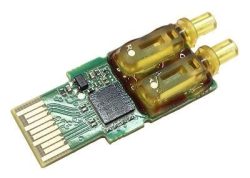
COB technology is become mature and widely used in many industries, especially in high-speed telecommunications. COB provides superior electrical and thermal performance. In the optical transceiver industry, COB is mainly used in 25G SFP28 SR, 40G QSFP+ SR4, 40G QSFP+ PSM4, 100G QSFP+ SR4, 100 QSFP+ PSM4, 25G AOC, 40G AOC and 100G AOC, etc.
What is a BOX Packaging Transceiver?
A BOX packaging is also called an airtight package. The optical chip is encapsulated in a metal box filled with inert gas to protect the optical components from the external environment and to improve heat dissipation. The optical path is isolated from the outside world by an optical window.
The figure below shows a BOX packaging 100G TOSA.
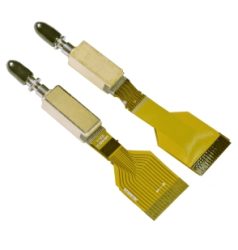
Compared with COB packaging, box packaging is traditional packaging technology with more stable optical and electrical performance. In the optical transceiver industry, BOX is mainly used in long-reach transceivers such as 25G SFP28 LR, 40G QSFP+ LR4, 40G QSFP+ ER4, 100G QSFP28 LR4, 100G QSFP28 ER4, 100G QSFP28 ZR4.
COB vs. BOX Packaging Transceiver Optics: What is The Difference?
Now let us compare COB vs. BOX packaging transceiver optics in the following aspects:
| Compare Difference | Chip on Board Optics | BOX Packaging Optics |
| Pricing | Lower | Higher |
| Reliability | Medium | High |
| Suitable Transceiver | SR Optics, PSM4 Optics, AOC | LR Optics, LR4 Optics, ER4 Optics, ZR4 Optics |
| Size | Smaller | Bigger |
| Application Scenarios | Data Center, 10G/40G/100G Ethernet | Telecom, Data Center, 10G/40G/100G Ethernet, 5G Wireless Network |
| Manufacturing complexity | Medium | High |
From the user’s point of view, the main difference between COB and BOX Packaging transceiver optics is the difference in performance, different use scenarios, and different prices.
FAQs about COB vs. BOX Packaging Transceiver
Q: Will you provide both COB and BOX Packaging Transceiver?
A: COB and BOX packaging optical transceivers are available in Optcore.
Q: What is the main application for the COB Packaging Transceiver?
A: The COB Packaging Transceiver is mainly used in short-reach applications such as 25G SFP28 SR, 40G QSFP+ SR4, 40G QSFP+ PSM4, and 100G QSFP+ SR4.
Q: What is the main application for the BOX Packaging Transceiver?
A: The BOX Packaging Transceiver is mainly used in long-reach applications such as 25G SFP28 LR,40G QSFP+ LR4, 40G QSFP+ ER4, 100G QSFP28 LR4, and 100G QSFP28 ER4.
Q: Which Packaging Transceiver is better for me?
A: It depends. COB packaging transceiver optics has the advantages of small form factor, low cost, and good heat dissipation. BOX packaging transceiver optics has the advantage of stable optical and electrical performance. You can choose according to your own needs.
Q: Can I use the BOX Packaging transceiver to replace the COB transceiver?
A: Yes, you can. COB and BOX packaging transceivers have the same electrical interface. They are compatible with each other. But you should not use a COB transceiver to replace BOX optics for telecom applications.
Q: Is Chip on board packaging transceiver optics reliable?
A: COB packaging transceiver optics is reliable. COB packaging technology is mature and has been widely used by many customers.
Q: What is the difference between COB and BOX packaging transceiver optics in optical performance?
A: BOX packaging transceiver has better optical performance due to the BOX airtight Construction and good heat dissipation.
Conclusion
The above COB vs. BOX packaging transceiver optics comparison shows that COB packaging provides better electrical and thermal performance. In contrast, BOX packaging offers stable optical and electrical performance. When choosing COB or BOX packaging, you should consider your specific application and make the best choice.
Optcore is an innovative manufacturer and supplier of high-quality COB and BOX packaging transceivers. We offer a wide range of COB and BOX packaging transceivers for your data center upgrade needs. Please contact us if you have any questions or need more information about COB vs. BOX packaging transceivers.
Read more:
- What is the difference between DAC and AOC Cables
- 10 Terms You Need to Know for 100G Transceiver Optics?
- Optcore QSFP28-100G-SR4 vs. QSFP28-100G-LR4 Compare, What Are The Key Differences?
